Choosing a filling capping machine is a crucial step for any production line seeking efficiency and product consistency. These machines are responsible for accurately filling bottles or containers and applying caps securely. Deciding between semi-automatic and fully automatic machines requires understanding production volume, product characteristics, and workforce availability. Selecting the right equipment ensures smooth operations, minimizes errors, and avoids unnecessary waste.
I. Semi-Automatic Filling Capping Machines
Overview:
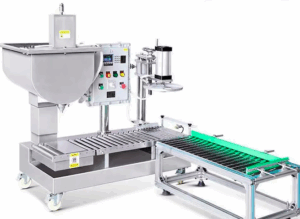
Semi-automatic filling capping machines are best suited for small-scale production or specialty batches. These machines can achieve filling accuracy of ±1–2%, depending on product viscosity, and produce around 20–60 bottles per minute.
Benefits:
- Affordable Investment: Lower initial cost compared with fully automated machines.
- Flexible Operation: Easier to switch between container sizes and product types.
- Simple Maintenance: Fewer moving parts allow faster cleaning and servicing.
Drawbacks:
- Labor Requirement: Operators must load and unload bottles manually.
- Slower Production: Not ideal for large-scale operations exceeding 100 bottles per minute.
- Operator-Dependent Consistency: Accuracy can vary with human handling.
II. Fully Automatic Filling Capping Machines
Overview:
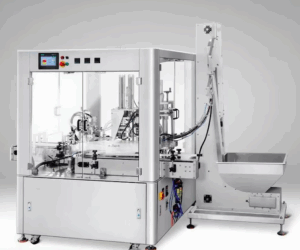
Fully automatic filling capping machines handle all aspects of the production process without constant human intervention. Containers are automatically fed, filled, and capped. They are suitable for a wide range of products, including liquids, pastes, powders, and granules. Filling precision generally reaches ±1%, with production speeds from 60–200 bottles per minute, depending on the number of filling heads and product properties.
Advantages:
- High Productivity: Capable of continuous operation with minimal human labor.
- Consistent Quality: Automation ensures uniform fill levels and proper capping.
- Scalable: Can integrate with additional packaging or labeling equipment.
Disadvantages:
- Higher Cost: Significant initial investment compared with semi-automatic models.
- Complex Maintenance: More components and sensors require regular checks and calibration.
- Reduced Flexibility: Switching between products or container sizes may take more effort.
III. Factors to Consider When Choosing a Machine
(1)Production Requirements
Semi-automatic machines are suitable for daily outputs below 1,000 units, while fully automatic machines are designed for high-volume production above 5,000 units per day. Assessing daily and monthly production targets helps identify the most cost-effective option.
(2)Product Characteristics
- Viscosity:Low-viscosity liquids can use either filling capping machine type, but thick sauces or gels need piston or rotary pump designs.
- Product Form:Powders and granules require precise dosing systems like auger fillers or screw conveyors.
- Bottle Size and Shape: Consider the machine’s adaptability to different container dimensions.
- Labor and Space
Semi-automatic machines require more operators, while fully automatic models reduce human involvement but need skilled technicians for setup and maintenance. Fully automatic machines also require more floor space for installation and operation.
(3)Budget Considerations
Balancing initial costs with long-term productivity is crucial. Semi-automatic machines are budget-friendly but less productive. Fully automatic machines are expensive upfront but can achieve higher efficiency and lower labor costs over time.
IV. Conclusion
Small-scale operations benefit from semi-automatic machines due to flexibility and lower investment, while high-volume manufacturers gain efficiency and consistency from fully automatic machines. By carefully evaluating production requirements, product characteristics, and operational constraints, manufacturers can choose the most suitable machine to achieve reliable filling capping machine, precise capping, and overall production efficiency.
0