As hygiene standards continue to evolve, automatic soap dispensers have become increasingly common in hotels and hospitals. For importers, wholesalers, and private-label businesses, working with a reliable automatic soap dispenser manufacturer can offer advantages beyond product purchasing, including cost management, customization, quality control, and supply chain stability.
Nonetheless, the success of this collaboration will depend on the manufacturer’s capabilities and the buyer’s needs. Knowing the key advantages will help companies that want to source from this kind of partner.
1. Lower Procurement Costs and Improved Profit Margins
Cost management is one of the primary considerations for distributors and retailers. Collaborating with the automatic soap dispenser manufacturer makes it easier to negotiate pricing, product specifications, order quantities, and packaging.
Reduce Additional Sourcing Costs
Direct cooperation will help minimize some intermediate costs and increase transparency in pricing discussions. In addition, buyers can determine what the quotation covers and identify additional costs before placing orders.
Nevertheless, direct procurement does not always ensure the lowest cost. Costs of shipping, import duties, inspections, and inventory must also be considered.
Evaluate the Total Cost of Ownership
A full analysis of purchasing shall involve:
- Unit pricing and discounts based on quantity.
- Packaging, freight, and import charges.
- Parts, maintenance, and warranty costs.
- Sample creation and customization costs.
For instance, when comparing quotes for 500 and 2,000 units, one can see how quantity affects the per-unit price and the amount of capital tied up in inventory.
2. Gain Flexible OEM and ODM Customization Options
Customization is especially valuable for businesses developing private-label products or expanding their existing product portfolios. An experienced automatic soap dispenser manufacturer may provide services that help buyers differentiate their products in competitive markets.
Understand OEM and ODM Services
The OEM process typically involves producing goods based on current designs or customer requirements. Some of the choices that can be made by the company include logo imprinting, customized packaging, choice of colors, and specification modification.
ODM services may involve more extensive product development, such as appearance design, structural adjustments, and functional improvements.
These options allow businesses to build a distinctive product range without investing in an entire manufacturing operation.
Plan Customization Projects Carefully
Prior to engaging in a project, buyers need to establish:
- Minimum order quantity (MOQ): Whether the needed quantity matches their sales expectations.
- Sample lead time: Time taken for evaluating the product.
- Tooling and development costs: If there are extra costs for a customized design.
- Specifications and intellectual property: Who holds the rights to the design and how it is modified.
For new brands, it may be ideal to customize an existing dispenser.
3. Strengthen Quality Control and Technical Communication
Automatic soap dispensers rely on several components, including sensors, pumps, seals, and control mechanisms. Communicating directly with automatic soap dispenser manufacturers will help buyers understand the technical specifications.
Evaluate Essential Performance Indicators
| Inspection item | What to evaluate |
| Sensor performance | Detection distance and response consistency |
| Dispensing accuracy | Output volume per activation |
| Sealing performance | Leakage around reservoirs and connections |
| Material quality | Housing durability and component reliability |
| Maintenance | Ease of refilling, cleaning, and replacing parts |
For example, a dispensing volume of approximately 0.5–2 mL per activation can serve as an initial comparison range for some products. The appropriate setting depends on the pump design, soap formulation, and intended application.
Establish Clear Quality Standards
Before mass production, the customer should approve product samples and ensure the technical specifications, packaging details, and testing process are clear.
At high sales volumes, it is also important to define the sampling technique, functional testing process, and procedure for rejecting bad units.
4. Improve Delivery Efficiency and Supply Stability
Late deliveries can result in stockouts, loss of sales opportunities, and disgruntled consumers. An efficient automatic soap dispenser manufacturer should be able to plan and manage their production processes effectively.
Coordinate Orders More Efficiently
Effective communication allows consumers to be aware of the status of production, packaging, and delivery. For custom-made products, approving the design in advance will avoid rework.
Build a More Reliable Replenishment Plan
In evaluating the supplier, take into account:
- Lead time for manufacturing standardized and customized goods.
- Ability to process huge orders.
- Availability of key components.
- Order tracking and delivery updates.
Buyers can also use monthly or quarterly sales forecasts to plan replenishment. This approach may reduce emergency purchases while helping prevent excess inventory.
5. Access Professional Product Knowledge and Application Support
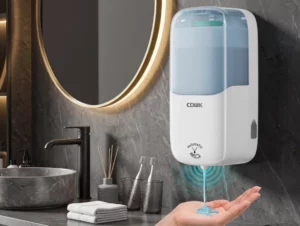
Needs vary by location. Appearance and usability would be the most important things in a hotel environment; however, in a hospital or toilet facility, durability and hygiene would play an important role.
Working with an experienced automatic soap dispenser manufacturer can help buyers select products that better match their target applications.
Match Product Specifications to Usage Scenarios
Reservoir capacity, mounting method, power supply, and dispensing type should all be considered. A 500 mL dispenser may suit some low- to medium-traffic environments, while a 1,000 mL or larger model may reduce refill frequency in busier locations.
Capacity needs should be determined based on estimates of daily consumption and refill schedule.
Confirm Compatibility and Maintenance Requirements
The type of soap used, liquid or foam, determines the pump mechanism. Before purchase, ensure you know the supported viscosity level, refilling method, battery requirements, and replacement parts.
Trial testing will identify potential problems and minimize maintenance costs and returns.
6. Build Long-Term Partnerships That Support Business Growth
Working with a manufacturer as a business partner goes beyond an individual order. A consistent business relationship benefits repeat orders, product development, and supply planning.
Secure After-Sales and Technical Support
It is important for buyers to determine the warranty terms, the debugging process, part availability, and liability for defective products before entering into any contract.
For ongoing purchasing programs, it is also important to understand how the supplier manages product changes and maintains the availability of essential components.
Prepare for Future Product Expansion
As sales volume increases, demand for dispensers in different capacities or designs may arise. A manufacturer with strong development and production capabilities can help meet these changing demands.
Starting with sample evaluations and a trial order lets buyers assess the supplier’s performance.
Conclusion
Working with an automatic soap dispenser manufacturer helps with cost management, product customization, quality control, delivery coordination, and technical support. This can be especially beneficial for importers, distributors, wholesalers, and manufacturers of private-label brands.
It does not always mean that the partner providing the lowest quotation will be the most suitable partner. The buyer should consider product efficiency, production facilities, delivery systems, customization capabilities, and after-sales service as a whole. With clear specifications, sample testing, and quality measures, organizations can reduce procurement risks and build a more reliable supply chain.
0