Choosing the right high-density connectivity solution is essential for achieving stable and high-speed performance. The MTP cable is widely used in data centers, enterprise networks, and telecom infrastructures where efficient multi-fiber transmission is required. However, many users often confuse MTP and MPO cables because they look similar and serve related purposes. Understanding the differences between them is crucial for selecting the right solution for 40G, 100G, and future high-speed network environments. While both are designed for multi-fiber connectivity, subtle variations in performance, design, and mechanical structure can significantly impact network efficiency.
Basic Definition and Structural Similarities
To understand the comparison, it is important to first recognize how MTP cables and MPO cables are structurally related.
- Shared multi-fiber architecture
Both MTP and MPO cables are designed to support multiple fibers (commonly 8, 12, or 24) within a single connector, enabling high-density fiber transmission in compact environments such as data centers. - Standard compatibility foundation
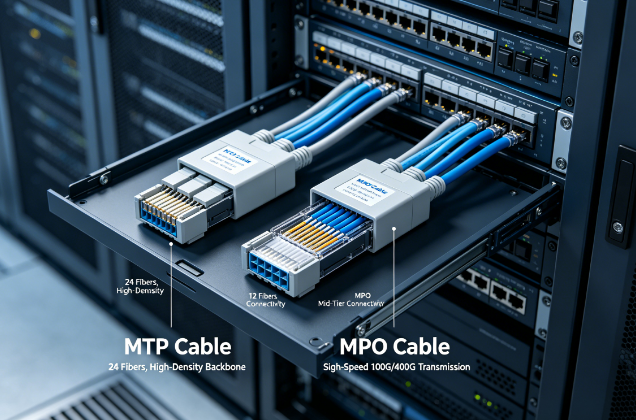
MPO is a standardized multi-fiber push-on connector defined by industry standards, while MTP is a high-performance enhanced version developed for improved mechanical and optical performance. - Similar external appearance but different precision levels
Although they look almost identical externally, MTP connectors typically offer tighter mechanical tolerances, improved alignment, and better optical performance compared to standard MPO connectors.
Performance Differences in Fiber Optic Networks
When comparing performance, the MTP cable generally provides higher precision and reliability in demanding applications.
- Enhanced low-loss design in MTP
MTP connectors are engineered with advanced ferrule design and floating structure, which helps reduce insertion loss and improve signal stability during high-speed transmission. - Better mechanical durability
Compared to standard MPO connectors, MTP versions are designed to withstand repeated plugging and unplugging cycles, making them more suitable for dynamic data center environments. - Improved alignment accuracy
The guide pin and housing system in MTP connectors allows more precise fiber alignment, which is critical for maintaining signal integrity in 40G and 100G networks.
Application Scenarios in Modern Infrastructure
Both cable types are widely used, but their applications often differ depending on performance requirements.
- MPO cables in cost-sensitive deployments
MPO cables are commonly used in general structured cabling systems where standard performance is sufficient, and budget optimization is a priority. - MTP cable in high-performance environments
The MTP cable is preferred in high-density data centers, cloud computing platforms, and enterprise backbone networks where low latency and high reliability are essential. - Use in parallel optics systems
Both are used in QSFP-based 40G and 100G parallel transmission systems, but MTP is more commonly selected for mission-critical environments due to its superior performance consistency.
Installation, Maintenance, and Reliability Comparison
Operational efficiency is another key factor when choosing between these two solutions.
- Simplified deployment for both types
Both MTP and MPO cables are typically pre-terminated, allowing plug-and-play installation that reduces labor costs and deployment time. - Higher stability of MTP in long-term use
The MTP cable offers better long-term performance stability, especially in environments with frequent reconfiguration or high connection density. - Maintenance considerations
MPO systems may require more frequent inspection in high-demand environments, while MTP systems are designed to minimize signal degradation and reduce maintenance frequency.
Cost vs Performance Considerations
Choosing between MTP and MPO often depends on balancing budget and performance requirements.
- MPO as a cost-effective solution
MPO cables are generally more affordable and suitable for standard applications where ultra-high precision is not critical. - MTP as a premium solution
The MTP cable typically comes at a higher cost due to its improved design and tighter manufacturing tolerances, but it delivers better long-term ROI in high-performance systems. - Strategic selection based on network scale
Large-scale data centers often mix both solutions depending on network layers, using MPO for general distribution and MTP for core high-speed links.
Conclusion
In summary, while both MTP and MPO cables serve similar purposes in multi-fiber connectivity, the MTP cable offers enhanced performance, better alignment accuracy, and improved durability, making it ideal for high-density and high-speed network environments. MPO cables remain a cost-effective option for standard deployments, but MTP cables are increasingly preferred in modern data centers and advanced fiber optic systems. Understanding their differences allows network designers to make more informed decisions, ensuring optimal performance, scalability, and long-term reliability in evolving digital infrastructures.
0