As data centers and enterprise networks continue to expand, high-density fiber cabling has become increasingly complex to design, install, and maintain. Growing bandwidth demands, limited physical space, and the need for faster deployment all place pressure on traditional cabling methods. The 24F MTP trunk cable has emerged as a structured solution designed to address many of these challenges. By integrating multiple fibers into a single high-density assembly it helps simplify cabling architecture while improving efficiency, reliability, and scalability in modern fiber optic environments.
Solving Cable Congestion and Physical Space Limitations
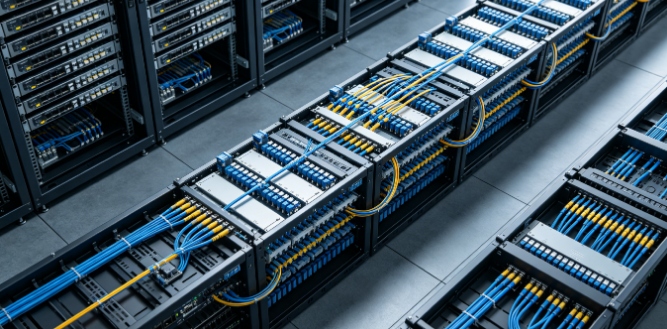
One of the most common problems in high-density fiber environments is cable congestion. As networks scale, racks and pathways quickly become overcrowded with individual fiber cables, making management difficult and inefficient. The 24F MTP trunk cable helps solve this issue by consolidating multiple fibers into one compact structure.
- Instead of running 24 separate fiber strands, all fibers are grouped into a single trunk, significantly reducing cable volume inside racks and trays
- Reduced cable density improves airflow within cabinets, helping maintain stable operating temperatures for active network equipment
- Cleaner physical layouts make it easier to design structured cabling systems without exceeding space limitations
By reducing physical clutter, the overall infrastructure becomes more organized, scalable, and easier to manage.
Reducing Installation Complexity and Human Error
Another major challenge in high-density cabling is installation complexity. Traditional fiber deployment requires extensive manual handling, including splicing, labeling, and individual fiber routing. The 24F MTP trunk cable addresses this by introducing a pre-terminated, plug-and-play structure.
From a practical installation perspective:
- Factory pre-termination eliminates the need for on-site fiber splicing, reducing both installation time and dependency on highly skilled technicians
- Standardized MTP/MPO connectors simplify connections between equipment and patch panels, reducing configuration mistakes during deployment
- Pre-tested fiber assemblies minimize performance inconsistencies, lowering the risk of post-installation troubleshooting
This streamlined process significantly improves installation accuracy and reduces project delays caused by human error.
Improving Maintenance and Troubleshooting Efficiency
In dense fiber networks, maintenance can become extremely time-consuming due to the difficulty of tracing individual connections. The 24F MTP trunk cable helps solve this by improving organization and visibility within cabling systems.
Key improvements include:
- Structured fiber grouping allows technicians to quickly identify specific cable paths without inspecting each strand
- Reduced cable clutter inside racks makes it easier to access and replace components during maintenance operations
- Lower risk of accidental disconnections, since fibers are bundled into a single controlled assembly
These advantages reduce downtime during troubleshooting and improve overall operational efficiency in mission-critical environments.
Supporting High-Speed Network Upgrades and Scalability
High-density fiber systems must support continuous upgrades as bandwidth requirements increase. The 24F MTP trunk cable is designed to support scalable and future-ready network expansion.
For example:
- It supports parallel optical transmission, making it suitable for 40G, 100G, and higher-speed network architectures
- Modular deployment allows additional trunk cables to be integrated without redesigning existing infrastructure
- Compatible with structured cabling systems, enabling smooth upgrades without major system disruption
This scalability ensures that network infrastructure can evolve alongside growing data demands without requiring complete replacement.
Enhancing Overall Cost Efficiency and Operational Stability
Beyond technical performance, cost and operational stability are major concerns in high-density fiber cabling projects. The 24F MTP trunk cable helps address these challenges by improving efficiency across the entire lifecycle of the network.
- Faster installation reduces labor costs and shortens project timelines
- Improved organization decreases long-term maintenance expenses
- High-density design reduces the need for additional physical infrastructure, optimizing capital investment
These combined benefits make the solution not only technically efficient but also economically sustainable for large-scale deployments.
Conclusion
The 24F MTP trunk cable effectively solves many of the key challenges in high-density fiber cabling, including cable congestion, installation complexity, maintenance difficulty, scalability limitations, and high operational costs. Its structured, pre-terminated design provides a more organized and efficient approach to modern fiber network deployment. For data centers and enterprise environments seeking reliable, scalable, and high-performance cabling infrastructure, it offers a practical and future-ready solution.
0