Touchless sanitation technology, which was once considered luxurious, has become standard for contemporary public facilities as well as commercial buildings. In places such as hotel entrances, corporate offices, busy airports, and hospitals, avoiding contact with the waste receptacle is crucial for preventing contamination. While there are many kinds of automation technologies that can achieve efficient sanitation, the intelligent sensor-based trash can remains one of the most useful systems for hands-free waste disposal. The operation process and engineering of a smart sensor trash can help us understand how simple body movements translate into elaborate electronic and mechanical actions.
1. Architecture of a Smart Sensor Trash Can
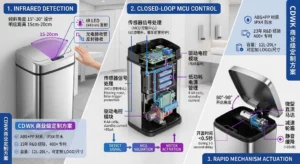
The design of a commercial-grade smart sensor trash can relies on the integration of multiple hardware components working together in precise, high-speed coordination. Instead of using simple mechanical buttons, every contemporary intelligent trash can employs unique micro-electronic components:
Infrared Sensor Module
Located near the opening of the bin at an angle of 15 to 30 degrees in order to cover an optimized detection area.
Microcontroller Unit (MCU)
Acts as the processing unit by receiving electrical signals from the sensor, filtering noise, and activating the motor.
Micro Electric Motor & Reduction Gearbox
Provides torque in 0.3-0.5 seconds to smoothly open the strong lid.
Power Management Circuit
Uses either 4 AA/AAA alkaline batteries or rechargeable lithium batteries that have an ultra-low idle current below 50 µA at 3.7V to 6V DC.
Enclosure Design
Made using high-density ABS plastic and impact-resistant PP material, making the enclosure IPX4 waterproof for the humid environment in the restroom.
2. Detailed Working Process of the Smart Sensor Trash Can
The working of the smart sensor trash can is an automated and closed-loop system that is designed for quick response, stability, and energy efficiency.
[TARGET ENTERS THE RANGE (15- 20 cm)] ➔ [INFRARED SIGNAL REFLECTION AND MCU DECODING] ➔ [ELECTRIC MOTOR DRIVES AND LID OPENS (< 0.5 s)] ➔ [DELAY COUNTDOWN (3-5 seconds)] ➔ [GEAR ENGAGEMENT FOR SOFT CLOSE]
Signal Transmission and Reception
Inside the sensor window, an infrared light-emitting diode (IR LED) continuously transmits an invisible light beam with a wavelength of about 940nm. When any object or hand comes close to the lid from 15 cm to 20 cm range, the light beam gets reflected and hits the adjacent phototransistor.
Signal Decoding and Filtering of False Triggers
The photo receiver converts light reflections to voltage signals and sends the signal to the MCU. The internal algorithm analyses the signal strength and length in order to confirm that there was deliberate motion. This makes it possible to avoid accidental triggering of the lid due to changes in lighting, shadows, and passing vehicles.
Motor Control and Fast Operation
Once the motion is confirmed, the MCU sends out a high signal that activates the micro DC motor. With the help of a reduction gearing mechanism, it increases the motor’s speed to produce the force needed to open the lid at 80°-90° angle in less than 0.5 seconds.
Delay Operation and Quiet Closing
If the user places the waste and moves away, the MCU starts a delay timer for 3-5 seconds. If there is no further movement, the motor reverses, or the dampening gear is released and closes the lid quietly, making no more than 35 dB of noise.
3. Comparison of Sensor Technologies Used in All Smart Trash Cans
Depending on the sensor technologies, we can observe different performance features in commercial settings:
| Sensor Technology | Operating Principle | Optimal Distance | Key Advantages | Typical Applications |
| Infrared Reflection (IR) | Emits and detects reflected 940nm light beams | 15 cm – 20 cm | Extremely low power usage, instant response (< 0.5 s), cost-effective | Commercial restrooms, offices, guest rooms |
| Ultrasonic Ranging | Measures transit time of 40kHz acoustic waves | 10 cm – 50 cm | Unaffected by target color, object transparency, or sunlight | Bright outdoor areas, sunlit atriums |
| Vibration / Capacitive | Detects physical impact or enclosure displacement | Direct touch or vibration | Hands-free “kick-to-open” activation | Busy commercial kitchens, surgical rooms |
This is the reason why infrared reflection is the most favorable option among leading brands such as CDWK because of its extremely low energy needs and quick operation.
4. Advanced Technologies in Commercial Smart Sensor Trash Can Development
Apart from the usual touchless operation, advanced technologies used in commercial smart sensor trash cans also include additional devices that help to enhance sanitary conditions and increase efficiency:
Odor Elimination & Sterilization
A special activated carbon filter or ultraviolet sterilizer in the UVB-C range (254 nm) can decrease bacteria by up to 99.9%, removing odor in the liner.
Auto Sealing & Pneumatic Bag Change
The most advanced smart trash cans use a thermal sealing mechanism for automatic closure of liners. Negative pressure created with the help of internal fans expands the new liner tightly and fills the space by more than 20%.
Energy Efficiency
Due to microamp consumption, a commercial smart trash can can work for 6 to 12 months with regular batteries, which means that this device is able to make 1000s of openings per day.
5. Procurement and Customization Guide for Public Facilities
Selection of Industrial Smart Sensor Trash Cans for Hotels, Airports, Shopping Centers, or Health-Care Institutions must correspond with actual operational requirements:
Traffic Volume Matching
Heavy traffic terminals need capacities that vary from 12L to 20L+, along with gearsets made of robust metal or high-quality plastic material designed to withstand heavy use.
Protection Against Infiltration
High levels of humidity at the terminal call for an IPX4 rating or higher, as well as conformal coating on the PCB.
Commercial OEM/ODM Customization
Working with experienced manufacturers such as CDWK—with their 23 years of industry experience, a specialized team of over 30 R&D specialists, and more than 400 national patents—it is possible to customize the body dimensions (slim or round design), finish the shell, set sensor ranges, and put on your own logo in accordance with ISO 9001 certification standards.
Conclusion
The smart sensor trash can uses infrared optics, a microcontroller to process information, and silent gear actuation. With increased interest in hygienic practices in all spheres of public life worldwide, adoption of the high-performance smart sensor trash can is a step to keep the facility clean and prevent contamination.
0