The Variegated Ficus is a highly valued ornamental plant known for its striking leaf patterns that combine green with creamy white or yellow sections. However, many plant owners notice that over time, these beautiful patterns may fade or disappear, with leaves turning mostly green. This process is known as “reversion” and is one of the most common issues affecting variegated plants. The loss of variegation in a Variegated Ficus is usually caused by environmental stress, improper care conditions, genetic instability, or propagation issues. Understanding these causes is essential for maintaining vibrant leaf patterns and ensuring long-term plant beauty.
1. Light conditions and their impact on variegation
Lighting is one of the most important factors influencing the appearance of a Variegated Ficus, and insufficient or improper light is a leading cause of variegation loss.
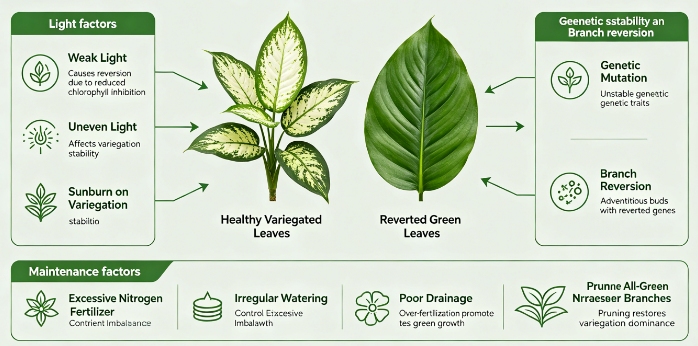
- Insufficient light exposure:
When the plant is placed in low-light environments, it increases chlorophyll production to survive, causing leaves to become greener and lose their variegated patterns. - Uneven light distribution:
If one side of the plant receives more light than the other, variegation may fade unevenly, resulting in inconsistent leaf coloration. - Too much direct sunlight:
Excessive harsh sunlight can damage delicate variegated areas, leading to browning or loss of patterned sections. - Solution approach:
Place the plant in bright, indirect light and rotate it regularly to ensure even exposure, helping maintain stable coloration.
2. Genetic instability and natural reversion
Another key reason why a Variegated Ficus loses its patterns is related to its genetic makeup, which can be unstable in certain cultivars.
- Chlorophyll dominance over time:
Some plant cells may gradually dominate, producing fully green leaves that outperform variegated cells in energy production. - Unstable mutation inheritance:
Variegation often results from natural mutations that are not always stable across new growth cycles. - Branch-level reversion:
Entire branches may revert to green if they grow more vigorously than variegated sections. - Long-term genetic behavior:
Without proper pruning, non-variegated growth may eventually overtake the plant.
To control this, growers often remove fully green shoots to preserve decorative foliage.
3. Watering, nutrients, and soil conditions
Improper care in watering and nutrition can also contribute to variegation loss in a Variegated Ficus, especially when the plant is stressed or unbalanced.
- Excess nitrogen fertilization:
High nitrogen levels encourage rapid green leaf growth, which can reduce visible variegation. - Inconsistent watering habits:
Irregular watering can stress the plant, causing it to prioritize survival growth over decorative patterns. - Poor soil drainage:
Waterlogged soil limits oxygen supply to roots, weakening overall plant health and affecting leaf quality. - Nutrient imbalance effects:
Lack of essential micronutrients can also reduce color contrast in leaves.
Maintaining balanced fertilization and consistent watering helps preserve stable variegation.
4. Pruning habits and growth management
Physical maintenance practices also play a major role in maintaining the appearance of a Variegated Ficus, especially when controlling unwanted green growth.
- Failure to remove green shoots:
Fully green branches often grow faster and can dominate the plant if not removed early. - Lack of shaping and trimming:
Without regular pruning, vigorous non-variegated growth may overshadow decorative sections. - Improper cutting techniques:
Cutting too much variegated growth can weaken the plant and encourage reversion. - Correct maintenance strategy:
Selective pruning of green branches helps redirect energy toward maintaining variegated foliage.
Consistent trimming ensures the plant retains its ornamental value over time.
Conclusion
The loss of leaf variegation in a Variegated Ficus is usually caused by a combination of light imbalance, genetic instability, improper watering or fertilization, and lack of pruning control. While some factors are environmental and can be corrected easily, others are natural and require ongoing maintenance to manage. By providing bright indirect light, maintaining balanced nutrition, ensuring proper watering habits, and regularly removing reverted growth, plant owners can significantly reduce variegation loss and keep their Variegated Ficus healthy and visually striking for years.
0