The company can package the identical product in containers that hold 100 ml, 250 ml, 500 ml, and 1 liter. Having different machinery for these would mean increased capital and space requirements.
An automatic filling machine may serve different sizes of bottles, given that the dosing and handling systems are adequate. Flexibility is not only dependent on the fill volume, but on nozzle clearance and bottle stability as well.
1. Can an automatic filling machine Handle Different Bottle Sizes?
Yes, many automatic filling machines can accommodate various-sized containers, as long as they are within the capacity of the machine.
Adjustable Filling Volume and Bottle Compatibility
Volume filling and the capability of handling bottles are two distinct factors. While a machine might be capable of filling between 100 ml and 500 ml, it is not necessarily going to handle all bottles in that range.
Several bottle dimensions need to be considered:
| Bottle Feature | Why It Matters |
| Bottle height | Determines nozzle positioning and conveyor clearance |
| Bottle diameter | Affects spacing, guides, and bottle positioning |
| Neck diameter | Determines whether the filling nozzle fits properly |
| Bottle shape | Influences stability and the need for special fixtures |
For instance, a 250 ml round bottle and a 250 ml square bottle contain the same volume, but they differ in terms of shape. Therefore, it is important to consider the volume and dimensions of bottles before purchasing a machine.
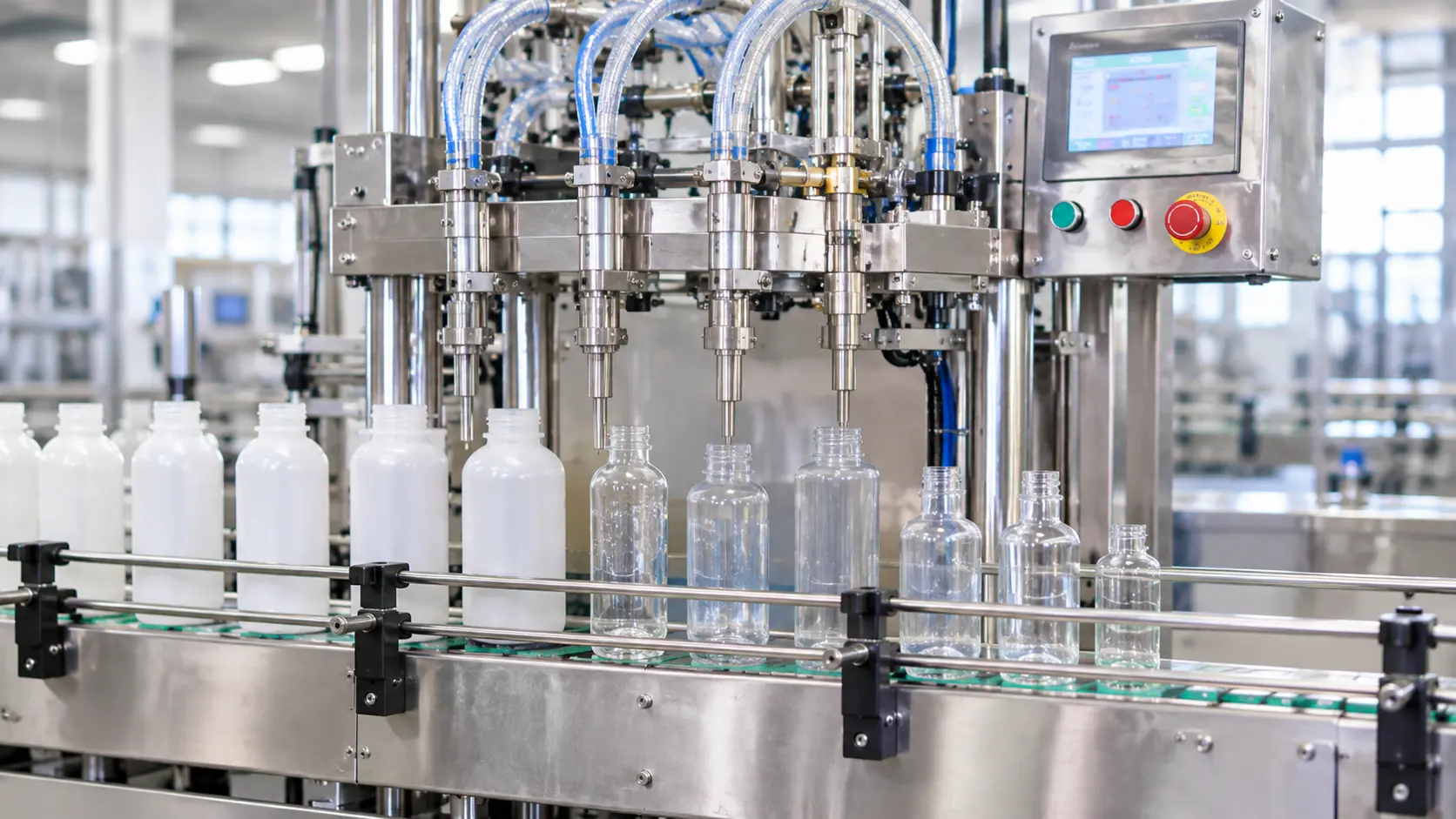
2. Key Components of an Automatic Filling Machine That Need Adjustment When Changing Bottle Sizes
However, when changing from one bottle size to another, various parts of the machine may need to be calibrated.
Filling Nozzles and Nozzle Height
Regarding the automatic filling machine, the nozzle needs to be calibrated in order to accommodate the opening of the bottle. The unnecessary space between the nozzle and the mouth may cause splashing, whereas insufficient penetration of the nozzle into the bottle would interfere with the process. The diving nozzles can prevent splashing of the foam able product.
Conveyor Belts and Bottle Positioning
The conveyor belt must be able to ensure that the bottles remain upright when passing beneath the fillers. Guide rail adjustments, as well as clamp or positioning system adjustments, will have to be done whenever the bottle size changes.
Some tall, skinny bottles might need help in order to prevent them from falling down, as well as strangely shaped bottles.
Filling Volume and Control System
If the capacity of the bottles is different, then the dose values of the automatic filling machine need to be altered according to the new capacity:
• For piston fillers: alter the stroke or programmed displacement within the operating range.
• For peristaltic fillers: alter the revolutions of the pump.
• For flow meter systems: alter the quantity set point and cutoff parameters.
Once this is done, test the filling operation for quantity, repeatability, dripping, and bottle stability.
3. How Different Filling Technologies of an Automatic Filling Machine Handle Multiple Bottle Sizes
Not all filling technologies offer the same level of flexibility. Their suitability depends on the product’s properties, container design, and production requirements.
Piston Filling Machines
In a piston filler, the material to be filled is loaded into the cylinder and then ejected with an accurate stroke of the piston. These filling machines are appropriate for use with a variety of viscous materials like soap, lotion, and syrup. For example, the ZS-YT2T-2PXD Automatic 2 Heads Servo Piston Pump Liquid Soap Filling Machine is an example of a servo piston metering machine. Changing over bottles will require checking the dose range, nozzle height, and bottle position.
Peristaltic Pump Filling Machines
In the peristaltic automatic filler machine, the rotation of the rollers causes compression of the tube, thereby pushing the fluid towards the nozzle. The liquid is not in contact with the pump mechanism, but with the tube within the pump. It becomes mandatory to change the settings of the pump and the size of the nozzle for different-sized bottles.
Vacuum Filling Machines
The operation of vacuum fillers is based on the differential pressure principle to pull the liquid into the right bottle. A vacuum filler is used when the liquid and the bottle are compatible with the process of filling. Some of the things that one should consider when moving to a new type of bottle include bottle strength, neck size, seal contact point, and fill point.
Overflow Filling Machines
Overflow fillers return excess liquid to the return line after achieving the desired fill level. The primary benefit is having the same visible fill level but not necessarily the same amount of liquid in each bottle. When changing bottles, it is important to verify nozzles, fill levels, overflow levels, and the stability of the bottle.
Conclusion
It should be noted that the automatic filling machine is capable of handling several types of bottle sizes, as long as the dosage range, nozzles, conveyor, and positioning systems match the kind of bottles. Before purchasing, it is recommended that you provide the manufacturer with the capacity, height, body size, and neck of the bottles that you intend to fill.
0