The global solar industry continues to expand as businesses and homeowners increasingly adopt renewable energy solutions. Among the various solar technologies available, monocrystalline panels are widely recognized for their superior efficiency and long-term performance. As a result, monocrystalline solar panel manufacturers play an essential role in supplying high-quality solar products for residential, commercial, and industrial projects. However, the leading manufacturers in this field stand out by combining advanced technology, strict quality standards, and reliable customer support to meet the growing demand for clean energy.
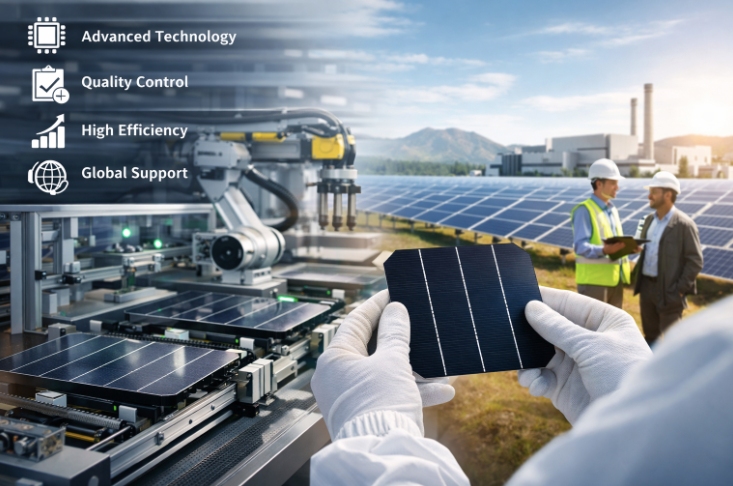
Advanced Manufacturing Technology
One of the most important factors that distinguishes top monocrystalline solar panel manufacturers is their commitment to advanced manufacturing technology. Producing monocrystalline solar panels requires highly refined silicon and precise crystal growth processes. Leading manufacturers invest heavily in automated production lines, precision equipment, and continuous innovation to improve product performance.
Many companies also integrate advanced cell technologies such as PERC (Passivated Emitter and Rear Cell), half-cut cells, and multi-busbar designs. These technologies increase light absorption and reduce electrical resistance, allowing solar panels to generate more electricity from the same amount of sunlight. By adopting these innovations, manufacturers can significantly enhance both efficiency and reliability.
Strict Quality Control Standards
Reliable monocrystalline solar panel manufacturers place strong emphasis on quality control across the entire production process. Since solar panels are expected to operate efficiently for 25 years or longer, maintaining consistent product quality is essential for long-term reliability and customer trust.
Leading manufacturers usually implement multiple layers of inspection and testing, including:
- Raw Material Verification
High-purity silicon is the foundation of monocrystalline panels. Manufacturers carefully inspect silicon wafers and other materials to ensure they meet strict purity and performance requirements before entering production. - In-Line Production Monitoring
During manufacturing, automated systems continuously monitor cell alignment, soldering quality, and electrical connections. This helps detect potential defects early and maintain stable production quality. - Environmental Stress Testing
Solar panels are tested under extreme conditions such as thermal cycling, high humidity, and temperature fluctuations. These tests simulate years of outdoor exposure to ensure panels remain durable in real-world environments. - Mechanical Load Testing
Panels must withstand wind pressure, snow loads, and physical stress. Mechanical load tests verify that the panel structure and glass layers remain stable under heavy pressure.
Through these strict quality procedures, top monocrystalline solar panel manufacturers ensure that their products meet international certification standards and deliver stable performance over decades of operation.
High Energy Conversion Efficiency
Another important factor that allows leading monocrystalline solar panel manufacturers to stand out is their ability to produce panels with high energy conversion efficiency. Monocrystalline solar cells are made from a single-crystal silicon structure, which allows electrons to flow more smoothly and reduces energy loss during power generation.
To further enhance efficiency, top manufacturers continuously improve cell design and module technology through innovation:
- High-Efficiency Cell Technology
Technologies such as PERC cells and advanced passivation layers allow panels to absorb more sunlight and convert it into usable electricity. - Optimized Cell Layout
Half-cut cells and multi-busbar designs reduce electrical resistance inside the panel, increasing overall power output. - Better Low-Light Performance
High-quality monocrystalline panels perform well even in cloudy or low-light conditions, allowing systems to generate electricity throughout the day. - Higher Power Output Per Area
Because of their efficiency, monocrystalline panels generate more electricity within limited installation space, making them ideal for residential rooftops and commercial buildings.
By focusing on efficiency improvements, top monocrystalline solar panel manufacturers help solar system owners produce more energy while maximizing the value of their solar investment.
Strong Industry Experience And Global Support
Experience and industry expertise are also key characteristics of top monocrystalline solar panel manufacturers. Companies with years of experience in solar technology development often have well-established production systems and strong research capabilities. Their knowledge enables them to continuously improve product design and manufacturing efficiency.
In addition, leading manufacturers usually provide comprehensive global support services. These services may include technical consultation, installation guidance, logistics support, and long-term warranties. Strong after-sales support helps customers operate solar systems with confidence and ensures that any technical issues can be resolved quickly.
Conclusion
In today’s rapidly growing renewable energy market, the success of monocrystalline solar panel manufacturers depends on several critical factors. Advanced manufacturing technology allows them to produce high-performance panels, while strict quality control ensures long-term reliability. High energy conversion efficiency helps customers generate more electricity from limited installation space, and strong industry experience enables manufacturers to deliver dependable support and service. By combining these strengths, leading manufacturers continue to drive innovation and provide sustainable energy solutions for the global solar industry.
0