In modern optical communication networks, a fiber faceplate is not only an optical interface component but also serves as a multi-channel fiber termination panel for FTTH, FTTO, and FTTD networks. It provides a reliable interface for connecting fiber cables and patch cords. One common question among network engineers and installers is, does the thickness of a fiber faceplate affect its performance? This article analyzes the relationship between fiber faceplate thickness and performance, focusing on its features, internal design, and practical installation considerations.
The Role of Fiber Faceplate in FTTH
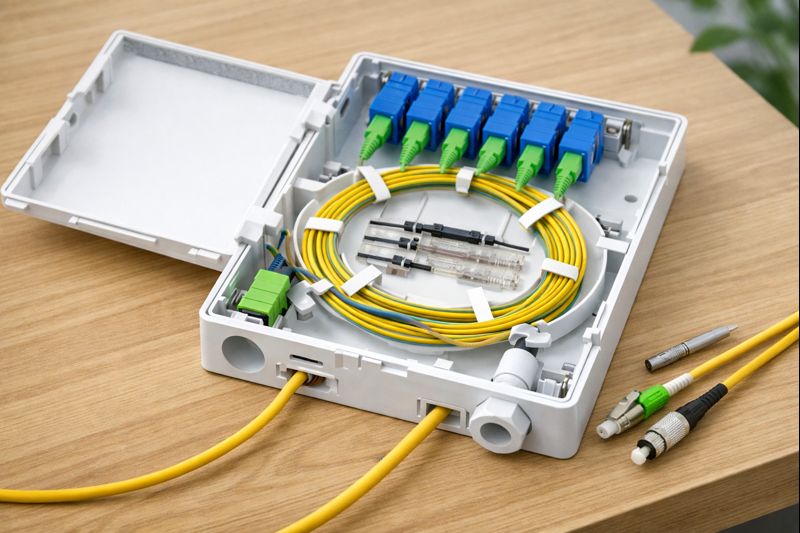
A fiber faceplate is a multi-channel fiber interface panel, typically providing 8 or 16 fiber channels. It integrates fiber splicing, storage, and cable connections within a durable protective enclosure. With a fiber faceplate, users can conveniently terminate fiber cables indoors while ensuring safe and stable transmission. For FTTH applications in homes and offices, the fiber faceplate acts as the entry point for fiber cables. Enabling patch cords to connect quickly and neatly to optical network terminal devices. It protects fibers from mechanical damage while preventing signal loss caused by dust, moisture, or operational errors.
Key Features of Fiber Faceplate
- Material: High-strength ABS plastic, durable and lightweight
Fiber faceplates are commonly made from high-strength ABS material. This material is lightweight, making it easy to handle and install, while also offering excellent impact resistance and heat resistance. The smooth surface reduces dust accumulation and provides corrosion and aging resistance, ensuring that the fiber faceplate remains stable and reliable over long-term use. - Applications: Suitable for FTTH, FTTO, and FTTD networks
Fiber faceplates are designed for multiple network architectures, including fiber to the home (FTTH), fiber to the office (FTTO), and fiber to the desktop (FTTD). Different deployment scenarios have varying requirements for channel density and internal space layout. A well-designed fiber faceplate balances channel density with adequate internal space, making it adaptable to a variety of installation environments. - Design: Snap-on cover reduces installation effort
The fiber faceplate features a snap-on cover that allows users to open or close the panel without additional tools. This design reduces installation time and lowers the risk of errors that may occur with screws or other fasteners. In environments that require frequent maintenance or upgrades, the snap-on design provides great convenience and efficiency. - Protection: Dustproof design, IP45 rated
The fiber faceplate’s enclosure meets the IP45 protection standard, effectively preventing dust from entering the internal fibers and interfaces while also safeguarding against water splashes. Dustproof design is critical for stable fiber signal transmission, significantly reducing attenuation caused by contamination and extending the service life of the fiber components. - Adapter Compatibility: SC, FC, LC
Fiber faceplates typically support multiple adapter types, including SC, FC, and LC, to meet different fiber device interface requirements. Supporting multiple adapters enhances the panel’s versatility, allowing users to upgrade or replace equipment without changing the entire fiber faceplate, thus reducing maintenance costs and effort. - Bend Protection: Large-diameter routing paths maintain fiber bend radius
The internal design of the fiber faceplate includes large-diameter routing paths to manage fiber bend radius and prevent excessive bending, which can lead to damage or signal loss. Proper bend protection ensures stable signal transmission, extends fiber lifespan, and helps organize high-density multi-channel cabling, maintaining a neat and orderly internal layout.
How Fiber Faceplate Thickness Affects Performance
- Mechanical Strength
Thicker fiber faceplates provide better mechanical strength, protecting internal fibers from external impact, compression, or stress. In high-density or multi-channel fiber faceplates, thickness directly affects structural stability and durability. Thinner panels may be more flexible and easier to install, but they are prone to deformation or cracking during handling or repeated patching, which can compromise the safety of the internal fibers. A properly thick fiber faceplate balances durability with manageable weight, ensuring consistent long-term performance. - Fiber Storage and Routing Space
Increased thickness provides more internal space for fiber routing and storage. Adequate space allows fibers to be arranged with the proper bend radius. Reducing the risk of fiber breakage and signal attenuation. Especially in high-density environments, a properly thick fiber faceplate can accommodate multiple fibers without crowding or crossing, making maintenance and fiber replacement easier and more efficient. - Ease of Installation
Excessively thick fiber faceplates can increase overall volume and weight, making installation more challenging and requiring additional space. Conversely, panels that are too thin may lack sufficient structural strength, unable to withstand repeated patching or external forces. A fiber faceplate with an appropriate thickness ensures mechanical stability while providing a convenient installation experience. Coupled with a snap-on cover, users can quickly complete fiber connections and maintenance without specialized tools.
Supported Splicing Methods
- Pigtail + Mechanical Splice + Adapter
This method is suitable for applications requiring high precision and long-term stability. The pigtail is connected to the adapter through a mechanical splice, minimizing signal loss and ensuring reliability. The fiber faceplate must have sufficient thickness and internal space to support the splice and fiber routing while maintaining proper clearance. - Pigtail + Fusion Sleeve + Adapter
Using a fusion sleeve to connect the pigtail and adapter is another common method. The sleeve requires secure internal placement within the fiber faceplate. A thicker fiber faceplate provides adequate space for the sleeve while maintaining the proper fiber bend radius and preventing signal attenuation. - Quick-install Connector + Adapter
Quick-install connectors are ideal for rapid deployment and temporary installations. An appropriately thick fiber faceplate ensures secure engagement between the connector and adapter while facilitating easy patching and maintenance. Too thin a panel may lack the space needed, while an excessively thick panel can increase footprint and cost, making thickness selection crucial.
Conclusion
While the thickness of a fiber faceplate primarily impacts mechanical strength, internal storage space, and installation convenience, it indirectly affects fiber signal stability and component lifespan. A properly thick fiber faceplate provides sufficient internal space for fiber routing and bend protection while maintaining structural integrity. For FTTH, FTTO, or FTTD networks, selecting a fiber faceplate with appropriate thickness is essential for ensuring stable fiber performance, simplified maintenance, and extended service life.
0