Selecting the proper provider of trunk cables plays a critical role in the provision of stable connections for networks in data centers, enterprise networks, and telecoms. The Trunk Cable Manufacturer selected must be reliable in providing quality trunk cables with flexible configurations, technical support, and prompt deliveries. It is also necessary to evaluate the manufacturer’s specifications and capabilities in customizing its services.
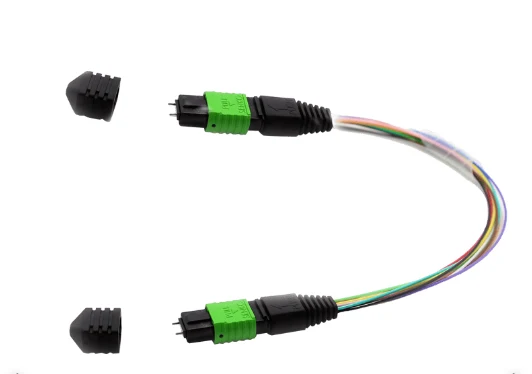
1. What Types of Trunk Cables Does the Manufacturer Offer?
Product variety is one of the first factors to consider when evaluating a Trunk Cable Manufacturer. Different network environments require different fiber types, core counts, connector configurations, and cable structures. A manufacturer with a suitable product range can help buyers avoid compatibility issues and unnecessary installation costs.
Fiber Count and Cable Configuration
Fiber count determines how many optical channels can be used with the trunk cable. Fiber counts include, but are not limited to, 8-fiber, 12-fiber, 24-fiber, 48-fiber, and 72-fiber. Higher counts support more connections in one cable assembly; thus, higher counts are better for installations that require density. Cable configuration must be selected according to the desired network configuration. For example:
- 8-fiber and 12-fiber: Applicable to smaller network connections and equipment interconnection.
- 24-fiber: Used in structured cabling and data centers.
- 48-fiber and over: Helpful for large installations where multiple optical connections are needed.
A professional manufacturer can assist buyers by showing all the configurations and selecting the proper fiber count for them.
Single-Mode and Multimode Trunk Cables
Different types of fibers determine the distance of transmission, applications, and compatibility with other pieces of equipment. Single-mode fibers, which are mostly found in OS2, can be used for long-distance transmission. The multimode fibers include OM3, OM4, and OM5.
| Fiber Type | Typical Wavelength | Common Application |
| OS2 | 1310/1550 nm | Long-distance links |
| OM3 | 850 nm | 10G and selected higher-speed links |
| OM4 | 850 nm | High-speed data center connections |
| OM5 | 850–953 nm | Wideband multimode applications |
A capable Trunk Cable Manufacturer should clearly identify fiber grades and provide specifications that help buyers match cables with transceivers and network equipment.
MPO, MTP, and LC Connector Options
The choice of connector impacts installation as well as the ability of equipment to work together. The MPO connector works with several optical fibers in one interface, whereas the MTP connector is an improved model of the MPO connector. LC connectors are commonly used to establish connections with single optical fibers. Buyers need to pay attention to the type of connector – male or female, pins, key alignment, and polarity.
2. How Does a Trunk Cable Manufacturer Ensure Product Quality?
The quality of the product will influence insertion loss, return loss, and connection integrity. A good Trunk Cable Manufacturer should ensure that there are specific guidelines for materials used and assembly, and not just rely on visual inspection alone.
Fiber Optic Materials and Connector Quality
The quality of the optical fiber itself is essential. Buyers must check the fiber brand, the fiber category, the attenuation specifications, and the cable construction. The quality of the connector is also important since inferior ferrule quality or misalignment may result in more optical losses.
For instance, typical insertion loss limits for various connectors are as follows: Single Mode Standard LC connectors would typically have an insertion loss of 0.2 to 0.3 dB; different values are possible for MPO connector assemblies.
Polishing and Assembly Processes
A reputable manufacturer can control polishing, fiber orientation, curing of the adhesives, and assembly process variability. Connector polishing has an impact on the surface contact and optical properties. Types of polishing are:
- UPC: It involves using a physical-contact surface that is slightly convex in shape.
- APC: It involves the use of an angled surface, usually at 8°, to minimize back reflections.
Testing and Quality Inspection Procedures
Before shipment, trunk cable assemblies should undergo appropriate optical and physical inspections. A Trunk Cable Manufacturer should be able to provide test reports or inspection records for relevant parameters. Important quality checks include:
- Insertion loss testing to test how much signal is lost in transmission from one end to another.
- Return loss testing to examine the reflected optical power.
- Polarity testing to ensure proper cable mapping.
- Visual inspection to check for any signs of contamination or damage
- Length testing and appearance testing to ensure compliance with order specifications.
For bigger projects, buyers must also be certain that the producer is capable of providing verifiable test results for each manufactured assembly or batch.
3. Does a Trunk Cable Manufacturer Have Strong Technical Capabilities?
Manufacturing experience is not enough if a supplier cannot understand the technical requirements of a network project. A capable Trunk Cable Manufacturer should provide engineering guidance and help buyers resolve configuration issues before production begins.
Cable Design and Engineering Support
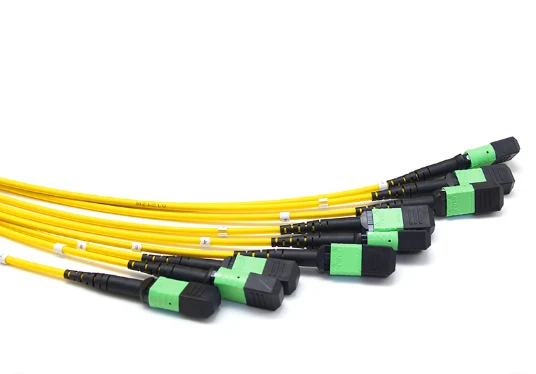
Different projects may require specific cable lengths, breakout structures, connector combinations, and installation methods. Technical teams should be able to review drawings, connection diagrams, and equipment requirements. For instance, a data center project using 12-fiber MPO connections may require specific breakout configurations to connect with LC duplex ports. Confirming the fiber mapping and polarity before production can help prevent installation problems.
Compatibility with Different Network Systems
All these components must be verified for compatibility throughout the entire connection path, such as the trunk cable, patch panel, cassette, transceiver, and switch.
The buyer must verify:
- Type of fiber used and wavelength of transmission.
- Interface of connector and gender.
- Fiber count and polarity arrangement.
- Supported transmission speed and equipment requirements.
Support for High-Density Data Center Applications
High-density cabling is increasingly important in data centers where rack space and cable management are limited. MPO-based trunk assemblies can consolidate multiple fiber connections into a single cable, reducing the number of individual cables that need to be routed.
As an illustration, a 24-fiber trunk cable can be designed to contain 24 optical fibers in one unit. If properly structured, such a cable is sure to offer ease in cabling routing, cable organization, and network extension.
4. Can a Trunk Cable Manufacturer Provide Customization?
Standard products may not meet every project’s requirements. Therefore, customization is another important factor when selecting a Trunk Cable Manufacturer. Buyers should check whether the supplier can adjust cable specifications without compromising compatibility or quality control.
Custom Cable Lengths and Fiber Counts
The length of the cable has to correspond to the distance between the two connection points while leaving room for routing and installing the cable. Typical customization requirements can be the length of the cable, number of fibers, breakout length, and jacket material. Before ordering, provide the supplier with installation drawings or exact measurements to avoid cable surplus or shortage and to manage cables easily.
Connector Types and Polarity Options
Customization can be made with MPO, MTP, LC connectors, among others. Confirm the polarity choice (Type A, Type B, or Type C) based on the network design. The polarity chosen has to suit the connecting devices and cabling design. The buyers have to ask for the wiring scheme.
Custom Labeling and Packaging
Clear identification is particularly useful when installing hundreds of cable assemblies across multiple racks. A Trunk Cable Manufacturer may provide custom labels containing cable IDs, fiber counts, lengths, or destination information. Packaging can also be adjusted according to transportation and storage requirements. Individual cable protection, product labels, and organized carton packaging help simplify inventory management and on-site installation.
Conclusion
The selection of a competent manufacturer for the Trunk Cables is not just based on price comparisons. Specifications, fiber requirements, connections, testing, technical support, and customization are all key aspects to consider when selecting a company to manufacture Trunk Cables. Potential buyers need to analyze the available technical data and even ask for sample products before ordering bulk shipments.
0