In recent years, large language models, commonly referred to as LLMs, have become one of the most influential technologies in the field of artificial intelligence. They power chatbots, writing assistants, translation tools, and even coding systems, making them appear highly “intelligent” in everyday use. This has sparked an ongoing debate: are they truly artificial intelligence, or are they just advanced statistical tools that simulate understanding? While LLMs can generate human-like responses and perform complex language tasks, their internal mechanisms are fundamentally different from human cognition. To answer this question, we need to look deeper into how they work, what they can do, and where their limitations lie.
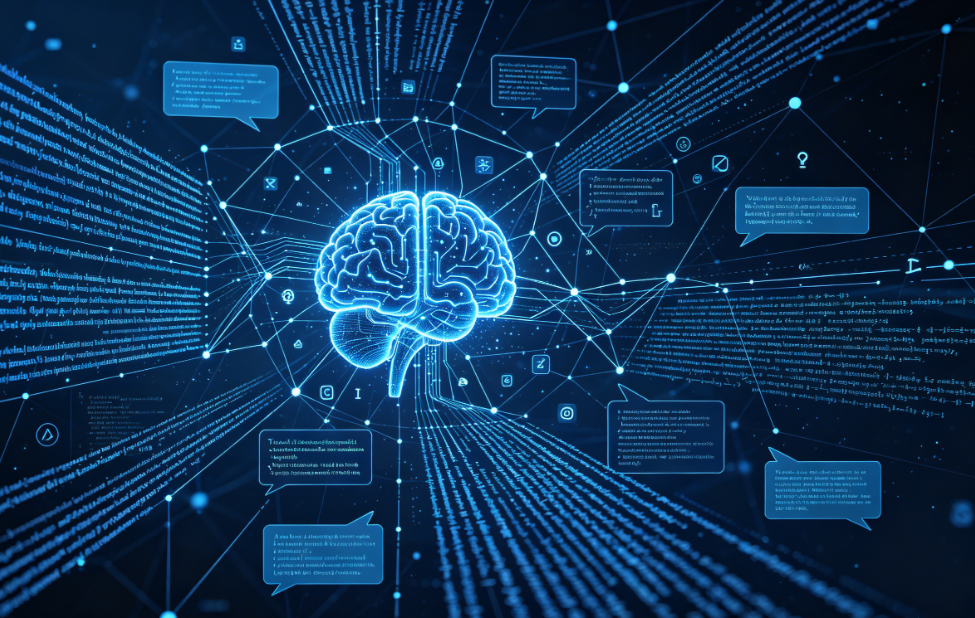
How LLMs Generate Human-Like Responses
To understand whether LLMs qualify as real AI, it is important to examine their core working mechanism.
- Pattern recognition from massive datasets
These models are trained on enormous amounts of text data, allowing them to learn statistical relationships between words and phrases rather than actual meaning. - Next-token prediction system
At their core, LLMsgenerate text by predicting the most likely next word in a sequence, which enables fluent but probabilistic responses. - Transformer-based architecture
Modern systems rely on transformer networks that allow them to analyze context across long passages and maintain coherence in output. - No inherent awareness or understanding
Despite their advanced performance, they do not “understand” language in a human sense; they process mathematical patterns instead.
Why LLMs Are Considered a Form of AI
Even though they operate differently from human thinking, LLMs are still widely classified as artificial intelligence systems.
- Ability to simulate intelligent behavior
They can write essays, summarize documents, translate languages, and answer questions in a way that feels intelligent to users. - Adaptability across industries and tasks
From customer service automation to legal drafting and software development, LLMs can be fine-tuned for specialized applications. - Learning-based improvement systems
Unlike traditional rule-based programs, they improve performance through training on data rather than fixed instructions. - Integration into AI ecosystems
They are often embedded in larger AI systems that include vision models, recommendation engines, and decision-support tools.
Limitations That Question “True Intelligence”
Despite their impressive abilities, there are clear reasons why some experts hesitate to call LLMs “real intelligence.”
- Absence of reasoning and consciousness
They do not think, reflect, or form opinions; their outputs are generated based on probability, not understanding. - Dependence on training data
Their knowledge is limited to what exists in their training datasets, making them unable to independently verify truth or discover new facts. - Inability to form goals or intentions
Unlike humans, they do not have desires or objectives; they simply respond to prompts without awareness of purpose. - Risk of generating incorrect or biased information
Since outputs are based on learned patterns, LLMs may reproduce errors or biases present in the data.
The Role of LLMs in Modern AI Development
Even with their limitations, LLMs play a crucial role in the broader evolution of artificial intelligence.
- Foundation for conversational AI systems
They have enabled the development of advanced chatbots that can interact naturally with users in real time. - Enhancement of productivity tools
Writing assistants, coding tools, and research platforms now rely heavily on LLMs to automate repetitive tasks. - Bridging human-machine communication
Natural language interaction makes technology more accessible to non-technical users, reducing barriers to digital tools. - Stepping stone toward advanced AI systems
Many researchers view LLMs as an intermediate stage toward more general and autonomous intelligence in the future.
Conclusion
In conclusion, whether LLMs are considered “real AI” depends largely on how artificial intelligence is defined. They clearly demonstrate intelligence-like behavior, such as generating language, solving problems, and adapting to different tasks, which places them firmly within the AI category. However, they lack true understanding, self-awareness, and independent reasoning, which distinguishes them from human intelligence. Therefore, LLMs can best be described as powerful narrow AI systems that simulate intelligence rather than possess it. As technology continues to evolve, it will likely become even more capable, further blurring the line between simulation and genuine intelligence.
0